Subscribe via email

Wednesday, 7 September 2011

Gang violence A rivalry between two gangs — Fresh Off the Boat (FOB) and the FOB Killers (FK)


Two suspected gang members went on trial Tuesday accused of shooting three people to death, including an innocent bystander, on New Year's Day in 2009. Three masked gunmen entered the Bolsa Vietnamese Restaurant in a southeast Calgary strip mall and opened fire, killing Sanjeev Mann, 22, described by police as a known gang member, and Aaron Bendle, 21, who also had gang ties. The third victim, construction worker Keni Su'a, 43, was eating in the restaurant and tried to escape, but was gunned down in the parking lot. Nathan Zuccherato, 24, Michael Roberto, 27, and Real Honorio, 27, are each charged with three counts of first-degree murder. Honorio's trial did not begin on Tuesday because his lawyer was unavailable. A publication ban was put in effect for the pre-trial arguments, which are expected to last two weeks. Gang violence A rivalry between two gangs — Fresh Off the Boat (FOB) and the FOB Killers (FK) — is believed to be connected to more than 20 homicides in Calgary dating back to 2002. In the days following the 2009 murders, police vowed to step up their work against gangs in Calgary. Officials have since credited that renewed focus with reducing the murder rate by almost 50 per cent the following year. The trial in Court of Queen’s Bench is scheduled to last for more than a month.

Tuesday, 6 September 2011

The Devil's Professor


erstwhile associate kinesiology professor at California State University at San Bernardino remains on the lam after police raided his home last week and found a pound of methamphetamine and a cache of guns. Police are charging that Stephen Kinzey, who had been on the San Bernardino faculty for a decade, was leading a double life: teaching and researching by day; directing the local chapter of an outlaw biker gang, and its drug business, by night. Not long after the manhunt began, Albert Karnig, the university’s president, emphasized that no one on the Southern California campus saw this coming: “To our knowledge, this is the first notice that anyone on our campus has had regarding this situation,” Karnig said. “…If the allegations are indeed true, this is beyond disappointing.” newspaper accounts described neighbors, students, and even Kinzey's father as having little or no sense of the professor's alleged outside activities. The Contra Costa Times quoted Kinzey's father as saying that he knew that his son belonged to a motorcycle gang and was not "thrilled" about it (the father taught him to ride). But Hank Kinzey also described his son as "a good Catholic boy" and a Republican, and added: "Everybody's always in denial when it's something to do with their family, but this is really surreal," he said. How could a full-time college professor run a drug ring on the sly without tipping his hand? Tom Barker, a professor of criminal justice at Eastern Kentucky University and leading scholar on outlaw biker gangs, says it is not hard to imagine. “It’s not uncommon for leaders or members of motorcycle gangs to hold down seemingly legitimate lives,” says Barker, even if part of their responsibility is to oversee an illegal drug business. “A college professor could easily pull it off.” Barker says he knows of at least two other college professors who are members of outlaw biker gangs, though he would not disclose their names because he says it could cost him his life. If Kinzey is the kingpin that police suspect he is, “he’s not actually that much involved in actual delivery of drugs,” says Barker. “He’s probably setting up the networks, and he can do that in the way he’s away from the classroom very easily.” In such crime organizations, most of the number-crunching falls to the secretary-treasurer, Barker says. The actual distribution falls to the members and their associates, the enforcer handles the dirty work, and the president’s leadership duties can be delegated to the vice president when necessary. While the chapter head is like the CEO of a small company, the illegal nature of the business means “there’s not a lot of paperwork,” says Barker. Barker says he is familiar with the Devil’s Diciples [sic], the gang Kinzey is alleged to have been running. And while he does not know specific details about the San Bernardino chapter, he says that the president of that chapter would have been in charge of anywhere between seven and 25 full-fledged gang members and a broad network of associates and business partners. He guessed the president of the chapter would personally pull in about a million dollars per year. As an associate kinesiology professor at San Bernardino, Kinzey was probably making around $70,000, according to the annual data produced by the American Association of University Professors. So if Kinzey was indeed the head of a lucrative drug ring, why continue to teach? Barker says that it may have been a fallback in case the kinesiology professor ever wanted to get out of organized crime. Heading the Devil’s Diciples might pay well, but it lacks the stability and retirement benefits of a state teaching job, Barker says. Another theory, he adds, is that Kinzey just loved to teach. Terry Rizzo, the chair of the kinesiology department at San Bernardino, did not respond to multiple requests for an interview; neither did Kinzey’s other colleagues. But student reviews on RateMyProfessors.com suggest that Kinzey had been popular among many students and passionate about his work. “Dr. Steve Kinsey is an amazing [professor], who helps his students in every situation, including in their greatest need,” wrote one student in 2007. “He is a good friend of mine and we continue to get together on a quarterly basis to catch up on life. Thank god for him, because I wouldn't be a graduate without him!!!!!” “He's so awesome!” wrote another, later that same year. “He has a passion for everything he does and it shows in his desire for students to succeed and understand.” More recent reviews paint a less flattering portrait, however. Kinzey “seems like he does not care anymore,” reported one reviewer in 2008. “im sure he is good at what he does he just isnt clear at all. talks all class and does not get anything done. kinda unorganized, but nice enough.” In 2010, a student wrote: “the professor sucks, he comes in late and doesn't care, if he try's to help you he'll end up rambling about himself.” And the last review before Kinzey became a fugitive, written last May, depicts a perpetually distracted instructor: “He's a really good guy and would give you the shirt off his back,” the reviewer wrote. “But something serious must have happened to him because he shows up late, and rambles on about random and controversial topics. He lost his focus & passion for teaching. His behavior lately makes it seem like he wants to get fired.” “Sad,” the student added, “because I really enjoyed all of his classes.”

Gang member sentenced to death in murder-for-hire scheme


gang member recruited in a murder-for-hire conspiracy was sentenced to death Thursday for killing a man who was set to inherit a family-run business in Rancho Dominguez, according to the Orange County district attorney’s office. Armando Macias, 35, of Lancaster was found guilty by a jury in April of one felony count of special circumstances murder with an allegation of murder for financial gain in the slaying of 44-year-old David Montemayor, the prosecutor's office said. Macias, who is the fifth defendant to be sentenced in connection with Montemayor’s murder since 2006, was also found guilty of kidnapping to commit robbery, possession of a firearm by a felon, street terrorism, attempted murder and two counts of conspiracy to commit murder, officials said. Macias, who has a prior strike conviction for voluntary manslaughter in 1993, also was slapped with several sentencing enhancements in connection with Montemayor’s murder. Prosecutors allege that in 2002, Montemayor’s sister Deborah Perna, 54, of Anaheim and her co-worker Edelmira Corona, 34, of Pico Rivera solicited the help of 44-year-old gang member Anthony Navarro of Canyon Country to kill Montemayor. Perna was jealous that her father intended to pass control of the family company to her brother, who she believed was stealing from the business, prosecutors said. Navarro recruited gang members Gerardo Lopez, 26, of Pacoima, Alberto Martinez, 33, of Castaic, and Macias in a kidnap-and-murder-for-hire scheme, prosecutors said. On Oct. 2, 2002, the men kidnapped Montemayor, a father of three, at the family business in Rancho Dominguez and headed to the victim’s home in Buena Park, where they were told he kept thousands of dollars in cash, prosecutors said. On the way, Montemayor, who only had one arm, managed to escape the car. But Macias shot him in the head as he fled, prosecutors said. Lopez also fired at Montemayor before the gang members raced off in their car, triggering a police car chase, authorities said. Police eventually stopped the vehicle and arrested Macias, Lopez and Martinez. Both Navarro and Martinez have been earlier sentenced to death for their role in Montemayor’s murder. Lopez, the other gang member, and Perna, the victim’s sister, were sentenced to life in prison without the possibility of parole, according to information from the district attorney's office. Corona, the co-worker, has pleaded guilty to manslaughter and is scheduled to be sentenced Oct. 18. She faces a maximum of 22 years in prison, officials said.

Texas Syndicate's Valley head gets 20 years; 5 fellow gang members also sentenced


Six members of the Texas Syndicate prison gang — including its Rio Grande Valley leader — were sentenced to serve time in federal prison for several charges including racketeering, kidnapping and drug charges. Chief U.S. District Judge Ricardo Hinojosa on Monday sentenced 40-year-old Jose Ismael Salas, the gang’s regional head, to 20 years in prison for drug and racketeering offenses, court records show. Salas originally pleaded guilty April 2, 2009, to two separate charges of possession with intent to distribute 6 kilograms of cocaine on Aug. 12, 2004, and a similar charge for 39 kilograms of marijuana on March 28, 2003. The charge alleged that the intent of the possession of the drugs was to further the goals of the criminal organization. Among the five other Texas Syndicate members who were sentenced was Fidel Valle, 45, who received a sentence of 10 years and six months in prison. Valle was described as the drug supplier for the organization. He entered a guilty plea July 28, 2009, to the charge of possession with intent to distribute 6 kilograms of cocaine. Court records show that Aug. 12, 2004, after speaking with Salas, Valle tried to sell the cocaine to other Texas Syndicate members but was stopped by authorities during a traffic stop. Also sentenced was Romeo Rosales, 41, who received 12 years and seven months in prison for the kidnapping of Amancio Pinales, who was abducted and eventually gunned down in Mexico on Aug. 12, 2004. Noel De Los Santos, 33, was sentenced to 20 years in prison in the March 20, 2003, murder of fellow gang member Crisantos Moran. According to information released by the U.S. Attorney’s Office, Moran had been ordered to kill a rival gang member from Peñitas, but after arriving there with De Los Santos and another member named Jose Armando Garcia, he failed to carry out the killing and was slain instead. Earlier this year, Garcia was given a life sentence. Two other Syndicate members were sentenced for a separate murder connected to the organization. Cristobal Hernandez, 31, and Arturo Rodriguez were sentenced to 10 and 20 years, respectively, for the murder of Marcelino Rodriguez in June 2007. The two men had aided a third man known as Raul Galindo, who shot Rodriguez in the back of the head. The two men then set the vehicle containing his body on fire. Rodriguez had been named in a sealed court document that had been provided to them by an employee at a law firm that was defending Rodriguez. The Texas Syndicate had sanctioned the death of Rodriguez.

Nine people stabbed to death, five killed in a deliberately set fire and an innocent grandmother’s body shoved in the trunk of her own car.


These troubling deaths are just a portion of Winnipeg’s climbing homicide cases this year. As of Thursday, Winnipeg has 29 homicides recorded, well above last year’s total of 22. Winnipeg’s deadliest year on record was 2004 when there was 34. “The numbers are a lot higher than we would like to see,” said Const. Jason Michalyshen, Winnipeg police spokesman. “It’s concerning to us, and it should be concerning to everyone.” The latest victim is Joseph Lalonde, 48, who was brutally beaten with a baseball bat. Two 15-year-old boys were charged with second-degree murder. A total of 10 youths have been charged in connection to the 2011 deaths. Michalyshen said it’s been a challenging year. “Our resources have been very busy making sure no stone is unturned, making sure that these investigations are investigated thoroughly, and arrests are made,” he said. Three cases are unsolved — Cara Lynn Hiebert, 31, was found dead in her home on Redwood Avenue on July 19; Baljinder Singh Sidhu, 27, was stabbed to death during a brawl on Osborne Street on Aug. 5; and 24-year-old April Hornbrook was found dead outside a building on Main Street on Aug. 27. Many violent crimes continue to occur in Winnipeg’s North End, a concerning stat for Coun. Harvey Smith (Daniel McIntyre). “The communities have to be working together and you don’t really have enough of that in the North End,” Smith said. “You have to have recreational activities, and ... I tend to think we should get more support for Citizens on Patrol.” Edmonton has the most homicides in Canada, with 34. Calgary has just three. “We’re very fortunate right now, but that could change before the end of the year,” said Calgary police Insp. Cliff O’Brien, who works in that city’s major crimes unit. O’Brien said there’s “no magical answer” for why the numbers are so low, but gave credit to the good work of officers and medical staff. Calgary police has a gang suppression team, who monitor entertainment districts, targeting known gang or organized crime members. “We have legislation here where we can kick people out if we can prove they’re associated with a gang,” he said. “That has helped us a lot.” O’Brien admits there’s a certain “element of luck.” “We’ve had those high rates before and I know that we will have those high rates again.”

Contract Killing On The Increase In Costa Rica


According to the Sección de Estadísticas del Departamento de Planificación del Poder Judicial (Statistics Section of the Planning Department of the Judiciary) the number of murders presumed by hired killers in 2010, went from 13 victims in 2009 to 40 in 2010, placing the La Carpio, Leon XIII, Los Cuadros y Guararí de Heredia as the places of highest incidence. Judicial authorities presume that organized crime groups, use this method to assert their interests in various criminal activities, as they are listed in order of importance: drug trafficking, gang revenge, robbery of drug traffickers (known as tumbonazos) and executions tied to the sale of illegal drugs. However, statistics show a slight increase in intentional homicides during the past year, compared to 2009, from 525 to 527 victims. The study found that the rate of homicide victims per 100.000 inhabitants remained virtually unchanged from 2009, settling at 11.5%. The existence of homicides associated with what is known as "error or omission," or those who were not the target and suffered mistaken identity or omission by the murderer, almost doubled in 2010 over 2009, for a total of 16 deaths. Also, the number of foreigners killed in the country increased by 7.6%, bringing the figure to 112 individuals, Nicaraguan and followed by Colombian nationals being the target. The use of firearms to commit homicide, again saw increases during 2010, bringing the total number to 319, which is equal numbers in 2008 and the highest throughout history. Good news for women as statistics indicate that the number of femicides dropped in 2010, from 15 victims in 2009 to 10 last year. However, the major cause of femicides continues to be attacks by cohabitants (60%) and spouses (40%). Contract or hired killing (sicario in Spanish) is a form of murder, in which one party hires another party to kill a target individual or group of people. It involves an illegal agreement between two parties in which one party agrees to kill the target in exchange for consideration, monetary, or otherwise. The hiring party may be a single person, a group of people, a company, or any other kind of organization. The hired party may also be one person, such as a hitman, or a group of people, or an organization. In most countries, including Costa Rica, a contract to kill a person is void, meaning that it is not legally enforceable. Any contract to commit an indictable offense is not enforceable. Furthermore, both the actual killer and the person who paid the killer can be found guilty of murder. Contract killing provides the hiring party with the advantage of not having to be directly involved in the killing. This makes it more difficult to connect that party with the murder. Throughout history and in many different parts of the world, contract killing has been associated with organized crime and also vendettas. For example, in recent United States history, the gang Murder, Inc., which committed hundreds of murders in the 1920s to the 1940s on behalf of the National Crime Syndicate, is a well-known example of a contract killer.

Vallucos gang members get life in prison for 'ice pick' murder


Cameron Park man accused of stabbing and killing a woman with an ice pick will spend the rest of his life in jail. After two and a half hours of deliberation, a Cameron County jury sentenced Ernesto Berlanga to life in prison for the August 2005 murder of Patricia Salas. The two had been fighting when he stabbed her in the neck and then fled the scene. Prosecutors previously identified Berlanga as a member of the Vallucos prison gang. Berlaga was already serving a 25-year sentence for gouging the eye of a fellow inmate at the Carrizales-Rucker Detention Center back in 2006.

Domestic helps’ accomplices prime suspects:


The two accomplices of the two domestic helps arrested for the murders of Juhu resident Kavita Suchak and her manager Prakash Bagwe on August 30 were the masterminds behind the murders said investigators, a day after arresting all four, two from Navi Mumbai and two from Nanded. Based on the investigations, police said the two domestic helps identified as Ram Singh Badaila and Tek Singh Badaila, also have a past crime record. According to Vishwas Nangre-Patil, Additional Commissioner (West region), the police are now compiling a database of domestic helps working in each society in the western region and their backgrounds would be checked. However, the victim had not verified the backgrounds of the two before hiring them, which made it difficult to trace them, said Nangre- Patil. The police arrested the Badailas and their accomplices from Navi Mumbai on Saturday. Nangre- Patil further said that the two Nepali nationals had been working for the Suchaks for the past five years. They had come in contact with two of their friends, Prem Bahadur Badaila and Bhim Bahadur Beek over the years. “The Suchaks owned a traditional safe in the house, apart from an electronic vault. The domestic helps hoped to find a large sum of money in the traditional safe. But the safe was empty as it was only maintained as a showpiece and as a object of faith. The gang bludgeoned Kavita with a crowbar when she returned home after dropping her kids to school a few minutes earlier than her usual schedule on August 30. Bagwe was strangled and gagged by the accused, as he had witnessed Kavita's murder and raised an alarm," Nangre-Patil added. The gang stole a laptop, three cellphones, jewellery and cash, collectively worth Rs 1.24 lakh. After leaving Kavita's house, the gang split up. Prem headed to Nerul in Navi Mumbai while the other three went to Pune. From Pune, they went to the house of a relative, Dev Bahadur, in Nanded. The police tracked down Prem first, by tracing the location of the stolen cellphones. “One of our teams went to Nepal and with the help of BSF kept a watch on the border to stop the accused from leaving the country. Another team went to Nanded with Prem,” said Pratap Dighavkar, Deputy Commissioner of Police (zone IX). Dressed in plainclothes, the policemen accompanied Prem to Dev Bahadur's house. “We did not want to reveal that Prem had been arrested, so we let him walk alone towards the house. Dev Bahadur came out of the house and Prem signaled to us that he was not a part of the gang. Prem then led us to Bhim who had sat in an autorickshaw and to Ram and Tek who were hiding in a water pipeline,” an official said. Bhim was arrested in the past for two cases of theft while Prem was booked for assaulting a government servant at MIDC. “The robbery at Suchak's residence was planned in detail. Bhim purchased a rope, crowbar, screwdriver and tape from Andheri. Tek who had keys to the vault was assigned the job of cleaning up the house while Ram kept watch. Prem and Bhim hid inside the house and struck after Kavita left for dropping her kids to school around 8.15 am,” an official said. So far, Rs 80,000 in cash has been recovered, besides some ornaments. The laptop was destroyed by the gang. “We are now trying to ascertain whether the Rs 80,000 is from the Suchak residence or elsewhere,” said Nangre-Patil.

70 stabbings in public view! Gruesome gang murders man in Ahmedabad


Yafizuddin Sheikh, a resident of Juhapura, was brutally killed when some people repeatedly ran a car over him and then stabbed him over 70 times on Friday night in Amraiwadi. Sheikh's assailants continued to stab him till he succumbed to his wounds on the spot. A murder complaint has been filed with the Amraiwadi police against members of the Daddu gang for the gruesome murder. Yafizuddin and another man Mohammad had gone to Bal Bhavan in Khokhra to meet his friend, one Harish Darbar alias Harry in their Maruti Esteem car.While the victim waited there to meet his friend, a group of people, in a Santro car, rammed into Yafizuddin. They then reversed the car and ran it over him again repeating the process thrice. They then came out and stabbed Yafizuddin so much so that he had around 70-odd stab wounds on his body when he died. The victim cried for help but a crowd that had gathered to make arrangements for the ongoing Ganesh Chaturthi did not bother to intervene. The people were allegedly afraid of the Daddu gang that is very notorious in the area for its anti-social activities. The attackers were identified as Daddu Vaghela, his nephew Divyaraj aka Montu along with Naresh Thakor alias Jigo, Rahul aka Chako, Suresh Thakor and Rakesh Bihola. Two more men on a motorcycle also accompanied them. They were identified as Prakash aka Kaaniyo and Rahul aka Kalu Bhil. Two others, who were also involved in the incident, remained unidentified. Daddu Vaghela is a notorious bootlegger of the city and along with his gang has around 21 cases registered against him. Vaghela is wanted by the cops in at least 11 cases from the same area. According to the complaint, the gang attacked the already injured Yafizuddin with their weapons and inflicted 70-odd wounds all over his body. The victim lay in a pool of blood before breathing his last. Police said that the incident was a fall out of a scuffle between Daddu gang and Harry. The victim had come to his friend Harry's rescue during the scuffle.Teams of detection of crime branch reached the scene to investigate the matter following direct orders from the city police commissioner.

In August, police captured Jose Antonio Acosta Hernandez, known as "El Diego," who is thought to be the leader of the La Linea gang,


In August, police captured Jose Antonio Acosta Hernandez, known as "El Diego," who is thought to be the leader of the La Linea gang, the enforcement arm of the Juarez cartel in the northern state of Chihuahua. Acosta, who is a former policeman, admitted to ordering the murders of 1,500 people. He is also thought to be involved with the death of three people with ties to the U.S. Consulate, including a consulate employee and her husband, in 2010. In June, police captured Acosta's second-in-command. Marco Antonio Guzman Zuniga, who is nicknamed "El Brad Pitt," was arrested on charges relating to a car bomb detonated outside a police station last year. Guzman is also thought to be behind hundreds of murders. Some shocking arrests have revealed an unimaginable depravity at the heart of this war. Edgar Jimenez Lugo, a 14 year-old San Diego boy, was convicted of murder, kidnapping and torture in July. Jimenez was arrested in Mexico in December, and admitted to decapitating four men for the South Pacific cartel. Police caught the boy, along with his sister, trying to board a plane to Tijuana. Lugo said that he was trying to flee to San Diego to see his mother and that the cartel had kidnapped and drugged him and forced him to kill. Earlier this year, police caught a 16-year-old girl trained to be an assassin by the Zetas gang. The Zetas also allegedly employed a 13 year-old girl who was caught in August. While Calderon is making some progress, each big-name capture creates new challenges. When one cartel leader is arrested or killed (often in shootouts with police) a rift forms in that cartel. In many instances, a fight for power between two deputies can leave hundreds dead in just a short time, and thousands dead in the long term as rival gangs vie for turf. That is the situation in Juarez, as well as Acapulco, where authorities recently discovered a mass grave, as well as the decapitated heads of five unknown people in a Sam's Club parking lot. Additionally, a July report that found that more than 400 police officers and investigators nationwide had been fired over corruption allegations proves just how ingrained these cartels are. The La Linea gang, for example, counts both current and retired cops as members, and in many cities, law enforcement officials, politicians and judges are either too afraid or being bribed too well to try to stop cartel activities. So the question remains, how effective is Calderon's drug war strategy? Is he making things better or worse? Mexico's current society is built to sustain these cartels, and no matter how hard he fights them, Calderon will make little progress. Instead, he needs to rebuild the society. Corruption needs to be fought just as hard as the drug traffickers who battle in the streets in make-shift tanks, and, more importantly, Mexico needs to work to combat economic disparity. Additionally, diplomatic tactics could prove to be more beneficial then force, a lesson that Nigeria's President Goodluck Jonathan is currently learning while fighting an Islamic militant group in his country. More often then not, Guns are met with more guns, but a well-planned strategy that involves a cease-fire coupled with economic and community development could go a long way. But until that happens, there will be more violence and more death.

Monday, 5 September 2011

Drug couriers killed in Chiang Rai


Two drug traffickers were killed and 22,200 methamphetamine pills seized late on Sunday night in a clash with a combined force of police and para-military rangers of the Pha Muang Force in Thoeng district of Chiang Rai province, police said. Pol Maj-Gen Songtham Alapach, the Chiang Rai police chief, said the combined police-ranger force laid in wait near Rom Pho Thong village in tambon Tap Tao of Thoeng district between kilometre markers 56-57 on the road to Phu Chi Fa mountain near the Thai-Lao border after learning that a drug gang would transport speed pills across the border from Laos. Late in the night, the combined force spotted five men carrying backpacks and AK47 rifles walking down from the mountain and ordered them to stop for a search. The smugglers opened fire and a 10 minute gunfight followed. After the clash, the police and rangers examined the area and found the bodies of two men who were killed in the fight.  One of them was identified as Laopho sae Wang, 50, a villager of Rom Pho Thong village, and the other was an unidentified Hmong from neighbouring Laos. The three other smugglers fled back across the border. A backpack containing 22,200 methamphetamine pills and a 9mm pistol were also found at the scene.

Wednesday, 24 August 2011

More Decapitated Bodies Found in Acapulco

Dozens of business are closed in Acapulco, Mexico, in protest of escalating drug cartel violence in the Pacific coast city.

Over the weekend, Mexican police found two headless bodies outside of a Sam's Club store in Acapulco. The bodies had been cut into more than 20 pieces, and authorities found the scalps and facial skin of the two people inside a woman's purse. They have not been able to locate the heads.

Relatives react after their arrival at a crime scene where four taxi drivers were shot dead at the Mexican beach resort of Acapulco August 18, 2011. According to local media, unidentified gunmen opened fire on four people in a taxi rank, with three men ending up dead outside their vehicles and one inside his car
Related Articles


On Saturday, police discovered three other decapitated bodies at a gas station about 650 feet from the Sam's Club. Police said on Monday that they found three severed heads in a duffel bag, but have yet to confirm if the heads belong to the bodies

Just a few days earlier, gunmen on the same street where the three bodies were found, shot and killed five people in broad daylight, including a state police officer.

Acapulco is a prime tourist destination for both Mexicans and Americans, but crime has skyrocketed recently as rival cartels vie for power. The city is in the state of Guerrero, where the La Familia and the Knights Templar gangs are especially active.

Last week, four taxi drivers were killed, just three days after a man was executed on a city bus. Last November, a mass-grave containing the remains of 18 kidnapped tourists was discovered outside the city.


Drug-related violence in Mexico exploded in 2006 when the government and President Felipe Calderon launched an offensive against organized crime. Since then, more than 41,000 people have been killed, including civilians, government officials and soldiers.

Recently, government forces have made a number of high-profile arrests. Earlier this month, police captured Jose Antonio Acosta Hernandez, known as "El Diego," who is thought to be the leader of the La Linea gang, the enforcement arm of the Juarez cartel in the northern state of Chihuahua.

Acosta, who is a former policeman, admitted to ordering the murders of 1,500 people. He is also thought to be involved with the death of three people with ties to the U.S. Consulate, including a consulate employee and her husband, in 2010.

In June, police captured Acosta's second-in-command. Marco Antonio Guzman Zuniga, who is nicknamed "El Brad Pitt," was arrested on charges relating to a car bomb detonated outside a police station last year.


Thursday, 18 August 2011

West Side gang member described by investigators as the “worst of the worst

West Side gang member described by investigators as the “worst of the worst” pleaded guilty Wednesday to multiple acts of murder and attempted murder.

Kyle Eagan, a member of the Tenth Street Gang, faces life in prison in connection with his plea to federal murder and racketeering charges.

As part of his plea deal, Eagan, 23, admitted killing a 16-year-old rival gang member in September 2008 and taking part in three attempted murders in 2009.

“This prosecution demonstrates the commitment of this office to protecting our citizens from some of the most egregious acts of violence occurring in our community,” U. S. Attorney William J. Hochul Jr. said in a statement.

FBI officials said Eagan’s plea will go a long way toward ending a long-standing feud between two violent West Side organizations — the Tenth Street and Seventh Street gangs.

Eagan was one of 35 people from both gangs charged in May with a wide range of criminal charges, including murder, attempted murder, assault and drug dealing.

“We’ve dismantled these two gangs, and that will have a great impact in the community,” said FBI spokeswoman Maureen P. Dempsey.

For years, police have blamed the two gangs for damaging the quality of life on the West Side. Authorities also believe Eagan was behind a lot of the violence there.

Thursday, he admitted that he and other Tenth Street gang members stole a car on Sept. 15, 2008, and that he shot and killed Omar Fraticello-Lugo on Busti Avenue.

Eagan also admitted that two other rival gang members were shot, but not killed, during the murder.

He also admitted to three attempted murders a year later, including a “drive-by” shooting in which he shot a rival gang member multiple times from close range.

The prosecution, led by Assistant U. S. Attorney Joseph M. Tripi, involved the FBI-led Safe Streets Task Force and included investigators from the State Police and Buffalo Police.

Formed in the late 1980s, the Tenth Street Gang dominated the West Side neighborhood bounded by Niagara Street to the west, Richmond Avenue to the east, Auburn Avenue to the north and Carolina Street to the south.

Gang members were known for “tagging” buildings and signs with graffiti to demonstrate their control of the neighborhood. They also were known for wearing plain white T-shirts and tattoos with “MOB” or “10” in the design.

Authorities arrested 17 people and seized several weapons in a Asian gang crackdown.


The suspects are part of five different Asian street gangs, some of them former rivals, who are "teaming up with the sole purpose of committing lucrative crimes," the Long Beach Police Department said in a statement. 
Evidence seized included handguns, methamphetamine, forged checks, personal profiles for alleged identity theft and Rolex and Movado watches, police said.

The reputed gang members allegedly were involved in home-invasion robberies, burglaries and thefts in the Long Beach area and Orange County. They were charged with felonies including forgery, fraud, drug possession, possession of stolen property and parole violations, the Long Beach Police Department said. Their names were not released.

The four-month investigation involved state parole agents and officers from the Long Beach, Fountain Valley, Garden Grove and Westminster police departments. Deputies from the Orange County and Los Angeles County Sheriff's departments also were part of the operation

Wednesday, 10 August 2011

If the police can't protect us, we'll protect ourselves VIGILANTES VIOLENCE

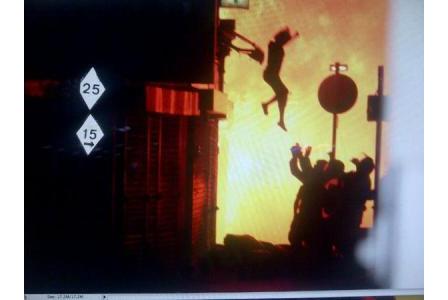
POLICE AND businesses in London prepared for a fourth night of unrest last night as widespread violence spread from north, to east, west and south.
Ger Donaghy, originally from Antrim, watched from his home above retail outlets on Ealing High Street in west London, as at least 200 youths, some as young as 16, ransacked businesses and attacked police.

He said rioters smashed and looted properties along the high street and set fire to a local convenience shop under a row of second-storey residential flats.

Mr Donaghy said he saw about five cars ablaze during the two-hour attack on Monday night, and witnessed the looting of two children’s clothes shops, an Oxfam charity shop and numerous cafes and restaurants.

“The rioters were kicking in windows of all the shops along the street and coming out of restaurants with chairs, bottles and whatever they could get their hands on to use as weapons to throw at the police.”

The crowd dispersed to other areas of Ealing at about midnight, and when local residents ventured out to assess the damage they found “children’s clothes littered all along the street” and “glass everywhere”. In Lewisham, a multi-ethnic area in southeast London, youths set fire to cars and bins and had running clashes with police outside a shopping centre, with unrest reported on Monday afternoon.

Looters broke into a jewellery shop and the windows of a local McDonald’s were smashed. The local bar had all its windows broken and was looted.

Rioters smashed their way into the Dirty South bar at about 7pm on Monday evening, tearing out fruit machines and fridges while also grabbing cash and alcohol. Bar manager Laura Warby said she was not on the premises when the looting took place and asked why the police were powerless to prevent the incident from happening.

“I am so shocked. I really have no idea why they would attack our place and why we weren’t protected by the police. This is going to cost thousands of pounds to repair,” she said.

There was a large police presence in Lewisham and in the neighbouring area of Catford yesterday evening, which also experienced some small pockets of copycat violence on Monday.

Further southeast in Bromley, the city’s biggest borough, police cordoned off the high street and train station yesterday afternoon, following sporadic flashes of violence in the area on Monday night.

Tensions were high in the area yesterday with many shops closing and some retailers boarding up amid fears of looting.

Sid Bussey, a local business owner in the nearby area of Downham, said shops were advised by police to close early with rumours that surrounding areas would be targeted by rioters.

“I’m refusing to close up early. Why should I?” he asked. “It’s the job of the police to protect us and our livelihood, and if they can’t protect us then we’ll have to protect ourselves.

“I’ve been here in this shop for the last 42 years and I’ll fight to the death before I let some kid loot it. This is nothing but kids with nothing better to do other than to cause trouble,” he said.


MOB violence' rocks Manchester

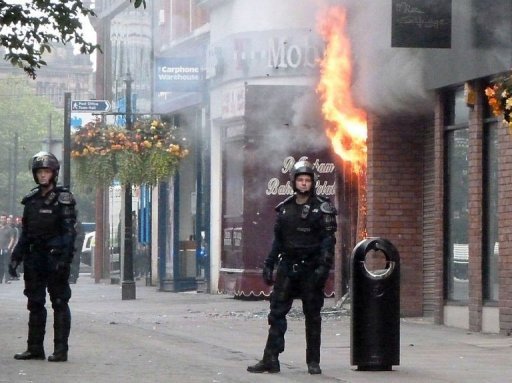
Police say they've been faced with extraordinary levels of violence on the streets of Manchester from hundreds of criminals hell-bent on causing destruction.

Fire bombs were thrown at shops and windows were smashed as looters made off with designer clothes, expensive electrical items, jewellery, mobile phones and alcohol as the violence gripping many English communities spread to the northwest city.

Youths - many wearing masks and hooded tops - plundered Manchester city centre and nearby Salford shopping precinct from about 5pm local time on Tuesday (0200 AEST Wednesday).

Some of those running wild looked to be as young as nine or 10.

The chaos ensued for hours and calm was not largely restored in both locations until about 1am as a total of 47 arrests were made with officers from Northumbria, Staffordshire and North Wales assisting Greater Manchester Police (GMP).

Sporadic looting broke out across the city centre with gangs playing cat and mouse with riot police, who took control street by street in a bid to flush out the offenders.

Former Oasis frontman Liam Gallagher's recently-opened fashion boutique - Pretty Green - fell victim to the looters, while a women's clothing store was set alight.

At Salford Shopping City, glass from shop windows and bus shelters littered the streets along with house bricks and rubble used to pelt riot police.

Two cars, one believed to be a BBC radio car, lay overturned and burnt out.

Firefighters came under attack from missile-throwing yobs as they attended incidents.

GMP Assistant Chief Constable Garry Shewan said: 'Criminals have brought shame in particular on the streets of Salford and Manchester.

'We want to make it absolutely clear - they have nothing to protest against. There is nothing in a sense of injustice and there has been no spark that has led to this. This has been senseless violence and senseless criminality of a scale I have never experienced in my career before.

'Over the past few hours, GMP has been faced with extraordinary levels of violence from groups of criminals intent on committing widespread disorder.

'This is nothing more than senseless violence with absolutely no regard for people, their property or livelihoods. These criminals have also attacked some of my officers and other emergency services who are simply trying to do their job to keep the public safe and restore order.'

He said that offenders had been caught on CCTV and his message for them was 'we will be coming for you'


Some armed with swords, some carrying hockey sticks, defiant Sikhs stood guard outside their temples last night.

Some armed with swords, some carrying hockey sticks, defiant Sikhs stood guard outside their temples last night.

More then 700 men, some in their 80s, took to the streets to protect the homes, businesses and places of worship in Southall, West London.

The locals rallied to keep the rioters at bay following reports of a planned attack on the area. It is just a few miles from Ealing, which was targeted on Monday night.

Each of the Sikh temples was guarded by around 200 men.

Resistance: Dozens of Sikhs stage a display of defiance against the rioters outside London's largest temple in Southall yesterday

Resistance: Dozens of Sikhs stage a display of defiance against the rioters outside London's largest temple in Southall yesterday

Amarjit Singh Klair from nearby Hounslow, who helped rally the men, said: ‘We are working along side the police, they’re doing what they can but they are stretched. 

‘Why shouldn’t we defend our homes, businesses and places of worship? This is our area. There’s lots of talk about it kicking off here. But we’re ready for them.’

Hooded youths could be seen scouting the area but appear to be have frightened off. Only a handful of police could be seen patrolling the area.


Monday, 1 August 2011

Police operation against triad and street gangs activities

Police yesterday (July 27) arrested 53 males and eleven women in an operation codenamed "Deepocean", which aimed at combating triad activities involving teenagers as well as street gangs activities.

Crime Unit of Kowloon East Region initiated the intelligence-led operation since January this year. An undercover police officer was deployed to gather crime information on several active triad societies in Kowloon East, involving cases in which teenagers were asked to take part in illegal activities.

The operation turned overt yesterday evening after in-depth investigation. Police raided various locations such as restaurants, cyber cafes and residences, resulting in the smashing of two gambling establishments and the seizure of small quantities of suspected cocaine and ketamine as well as some offensive weapons including beef knives, water pipes and extended batons.

In the operation, eleven women aged between 29 and 65 were arrested for illegal gambling related offences.

The remaining male arrestees, aged between 13 and 44 and including suspected core members of triad societies, were arrested for various offences including managing a triad society, claiming to be a member of a triad society, acting as a member of a triad society, robbery, wounding, criminal damage, trafficking in dangerous drugs and illegal gambling.

The operation is still under way. It is believed that the operation succeeded in combating triad and street gangs activities in the region. Police will continue to take enforcement action and step up patrols at venues frequented by teenagers, particularly during the summer vacation.


One of Israel's top organized crime figures has been gunned down in a drive-by shooting.


Police say two men on a motorcycle opened fire on Francois Abutbul early Sunday as he stopped to fill up at a gas station north of the coastal city of Netanya.

Police say the Abutbuls are one of the most powerful families in Israeli organized crime. Abutbul ran the family business along with his brother Assi, who serving jail time for extortion, arson and unlawful imprisonment.

The family patriarch, Felix, was assassinated in 2002 at a Prague casino.

Gang violence has been rising in recent years, with incidents of rocket attacks, bombings and shootings in public places.

Police say one of Abutbul's bodyguards was lightly wounded in the shooting. No suspects have been arrested.

Drug gang leader says he ordered 1,500 killings

suspected leader of the Juarez drug cartel told authorities he had ordered the deaths of about 1,500 people, a Mexican federal police official said Sunday.
Federal police detailed accusations against Jose Antonio Acosta Hernandez, known as "El Diego," a day after authorities announced his capture. He was one of the country's most wanted criminals, with officials offering a reward of 15 million pesos ($1.3 million) for his arrest.
Collaboration with the U.S. Drug Enforcement Administration led to Acosta's detention, said Eduardo Pequeno, head of the Mexican federal police anti-drug unit.
Acosta is accused of being a leader of the drug gang known as La Linea, the enforcement arm of the Juarez cartel, Mexican authorities have said.
Pequeno told reporters that Acosta "said he ordered the killings of about 1,500 people, mostly in Ciudad Juarez and Chihuahua's capital."
An investigation points to Acosta as the mastermind behind the March 2010 killing of three people connected with the U.S. Consulate in Juarez, Pequeno said.
More recently, Acosta ordered operatives to hang banners with threatening messages directed at the DEA and other U.S. authorities, Pequeno said.
Juarez, Mexico's most violent city, shares a border with El Paso, Texas.
Pequeno also accused Acosta of having connections with some of the border city's most notorious violence over the past two years, including the 2010 killing of a state prosecutor, a car bombing outside a police station and a massacre at a house party that killed 15 people -- most of them students with no ties to organized crime.
Acosta told authorities the targets of his criminal organization included police, government officials, rival drug gangs and civilians, Pequeno told reporters.
Earlier this month, the U.S. consulate in Juarez issued a statement warning "American citizens to remain vigilant" based on information it had received that cartels may target the consulate or entry points on the U.S.-Mexico border.
The northwestern Mexican state of Chihuahua, which contains the namesake capital city as well as Juarez, has been a hotbed for drug-related violence.
The federal government has been targeting cartels' operations, and especially its leaders, in an ongoing battle.
Mexican authorities have arrested several others they accuse of being connected to the slayings of three people connected with the consulate last year.
The shootings occurred March 13, 2010, when consulate employee Lesley Enriquez and her husband, Arthur Redelfs, were gunned down as they left a birthday party in their white SUV.
Jorge Alberto Salcido Ceniceros, the husband of another consulate employee, was killed in a separate vehicle.


Related Posts Plugin for WordPress, Blogger...

 
Design by Free WordPress Themes | Bloggerized by Lasantha - Premium Blogger Themes | Blogger Templates