Subscribe via email

Tuesday, 6 September 2011

Vallucos gang members get life in prison for 'ice pick' murder


Cameron Park man accused of stabbing and killing a woman with an ice pick will spend the rest of his life in jail. After two and a half hours of deliberation, a Cameron County jury sentenced Ernesto Berlanga to life in prison for the August 2005 murder of Patricia Salas. The two had been fighting when he stabbed her in the neck and then fled the scene. Prosecutors previously identified Berlanga as a member of the Vallucos prison gang. Berlaga was already serving a 25-year sentence for gouging the eye of a fellow inmate at the Carrizales-Rucker Detention Center back in 2006.

Domestic helps’ accomplices prime suspects:


The two accomplices of the two domestic helps arrested for the murders of Juhu resident Kavita Suchak and her manager Prakash Bagwe on August 30 were the masterminds behind the murders said investigators, a day after arresting all four, two from Navi Mumbai and two from Nanded. Based on the investigations, police said the two domestic helps identified as Ram Singh Badaila and Tek Singh Badaila, also have a past crime record. According to Vishwas Nangre-Patil, Additional Commissioner (West region), the police are now compiling a database of domestic helps working in each society in the western region and their backgrounds would be checked. However, the victim had not verified the backgrounds of the two before hiring them, which made it difficult to trace them, said Nangre- Patil. The police arrested the Badailas and their accomplices from Navi Mumbai on Saturday. Nangre- Patil further said that the two Nepali nationals had been working for the Suchaks for the past five years. They had come in contact with two of their friends, Prem Bahadur Badaila and Bhim Bahadur Beek over the years. “The Suchaks owned a traditional safe in the house, apart from an electronic vault. The domestic helps hoped to find a large sum of money in the traditional safe. But the safe was empty as it was only maintained as a showpiece and as a object of faith. The gang bludgeoned Kavita with a crowbar when she returned home after dropping her kids to school a few minutes earlier than her usual schedule on August 30. Bagwe was strangled and gagged by the accused, as he had witnessed Kavita's murder and raised an alarm," Nangre-Patil added. The gang stole a laptop, three cellphones, jewellery and cash, collectively worth Rs 1.24 lakh. After leaving Kavita's house, the gang split up. Prem headed to Nerul in Navi Mumbai while the other three went to Pune. From Pune, they went to the house of a relative, Dev Bahadur, in Nanded. The police tracked down Prem first, by tracing the location of the stolen cellphones. “One of our teams went to Nepal and with the help of BSF kept a watch on the border to stop the accused from leaving the country. Another team went to Nanded with Prem,” said Pratap Dighavkar, Deputy Commissioner of Police (zone IX). Dressed in plainclothes, the policemen accompanied Prem to Dev Bahadur's house. “We did not want to reveal that Prem had been arrested, so we let him walk alone towards the house. Dev Bahadur came out of the house and Prem signaled to us that he was not a part of the gang. Prem then led us to Bhim who had sat in an autorickshaw and to Ram and Tek who were hiding in a water pipeline,” an official said. Bhim was arrested in the past for two cases of theft while Prem was booked for assaulting a government servant at MIDC. “The robbery at Suchak's residence was planned in detail. Bhim purchased a rope, crowbar, screwdriver and tape from Andheri. Tek who had keys to the vault was assigned the job of cleaning up the house while Ram kept watch. Prem and Bhim hid inside the house and struck after Kavita left for dropping her kids to school around 8.15 am,” an official said. So far, Rs 80,000 in cash has been recovered, besides some ornaments. The laptop was destroyed by the gang. “We are now trying to ascertain whether the Rs 80,000 is from the Suchak residence or elsewhere,” said Nangre-Patil.

70 stabbings in public view! Gruesome gang murders man in Ahmedabad


Yafizuddin Sheikh, a resident of Juhapura, was brutally killed when some people repeatedly ran a car over him and then stabbed him over 70 times on Friday night in Amraiwadi. Sheikh's assailants continued to stab him till he succumbed to his wounds on the spot. A murder complaint has been filed with the Amraiwadi police against members of the Daddu gang for the gruesome murder. Yafizuddin and another man Mohammad had gone to Bal Bhavan in Khokhra to meet his friend, one Harish Darbar alias Harry in their Maruti Esteem car.While the victim waited there to meet his friend, a group of people, in a Santro car, rammed into Yafizuddin. They then reversed the car and ran it over him again repeating the process thrice. They then came out and stabbed Yafizuddin so much so that he had around 70-odd stab wounds on his body when he died. The victim cried for help but a crowd that had gathered to make arrangements for the ongoing Ganesh Chaturthi did not bother to intervene. The people were allegedly afraid of the Daddu gang that is very notorious in the area for its anti-social activities. The attackers were identified as Daddu Vaghela, his nephew Divyaraj aka Montu along with Naresh Thakor alias Jigo, Rahul aka Chako, Suresh Thakor and Rakesh Bihola. Two more men on a motorcycle also accompanied them. They were identified as Prakash aka Kaaniyo and Rahul aka Kalu Bhil. Two others, who were also involved in the incident, remained unidentified. Daddu Vaghela is a notorious bootlegger of the city and along with his gang has around 21 cases registered against him. Vaghela is wanted by the cops in at least 11 cases from the same area. According to the complaint, the gang attacked the already injured Yafizuddin with their weapons and inflicted 70-odd wounds all over his body. The victim lay in a pool of blood before breathing his last. Police said that the incident was a fall out of a scuffle between Daddu gang and Harry. The victim had come to his friend Harry's rescue during the scuffle.Teams of detection of crime branch reached the scene to investigate the matter following direct orders from the city police commissioner.

In August, police captured Jose Antonio Acosta Hernandez, known as "El Diego," who is thought to be the leader of the La Linea gang,


In August, police captured Jose Antonio Acosta Hernandez, known as "El Diego," who is thought to be the leader of the La Linea gang, the enforcement arm of the Juarez cartel in the northern state of Chihuahua. Acosta, who is a former policeman, admitted to ordering the murders of 1,500 people. He is also thought to be involved with the death of three people with ties to the U.S. Consulate, including a consulate employee and her husband, in 2010. In June, police captured Acosta's second-in-command. Marco Antonio Guzman Zuniga, who is nicknamed "El Brad Pitt," was arrested on charges relating to a car bomb detonated outside a police station last year. Guzman is also thought to be behind hundreds of murders. Some shocking arrests have revealed an unimaginable depravity at the heart of this war. Edgar Jimenez Lugo, a 14 year-old San Diego boy, was convicted of murder, kidnapping and torture in July. Jimenez was arrested in Mexico in December, and admitted to decapitating four men for the South Pacific cartel. Police caught the boy, along with his sister, trying to board a plane to Tijuana. Lugo said that he was trying to flee to San Diego to see his mother and that the cartel had kidnapped and drugged him and forced him to kill. Earlier this year, police caught a 16-year-old girl trained to be an assassin by the Zetas gang. The Zetas also allegedly employed a 13 year-old girl who was caught in August. While Calderon is making some progress, each big-name capture creates new challenges. When one cartel leader is arrested or killed (often in shootouts with police) a rift forms in that cartel. In many instances, a fight for power between two deputies can leave hundreds dead in just a short time, and thousands dead in the long term as rival gangs vie for turf. That is the situation in Juarez, as well as Acapulco, where authorities recently discovered a mass grave, as well as the decapitated heads of five unknown people in a Sam's Club parking lot. Additionally, a July report that found that more than 400 police officers and investigators nationwide had been fired over corruption allegations proves just how ingrained these cartels are. The La Linea gang, for example, counts both current and retired cops as members, and in many cities, law enforcement officials, politicians and judges are either too afraid or being bribed too well to try to stop cartel activities. So the question remains, how effective is Calderon's drug war strategy? Is he making things better or worse? Mexico's current society is built to sustain these cartels, and no matter how hard he fights them, Calderon will make little progress. Instead, he needs to rebuild the society. Corruption needs to be fought just as hard as the drug traffickers who battle in the streets in make-shift tanks, and, more importantly, Mexico needs to work to combat economic disparity. Additionally, diplomatic tactics could prove to be more beneficial then force, a lesson that Nigeria's President Goodluck Jonathan is currently learning while fighting an Islamic militant group in his country. More often then not, Guns are met with more guns, but a well-planned strategy that involves a cease-fire coupled with economic and community development could go a long way. But until that happens, there will be more violence and more death.

Monday, 5 September 2011

Drug couriers killed in Chiang Rai


Two drug traffickers were killed and 22,200 methamphetamine pills seized late on Sunday night in a clash with a combined force of police and para-military rangers of the Pha Muang Force in Thoeng district of Chiang Rai province, police said. Pol Maj-Gen Songtham Alapach, the Chiang Rai police chief, said the combined police-ranger force laid in wait near Rom Pho Thong village in tambon Tap Tao of Thoeng district between kilometre markers 56-57 on the road to Phu Chi Fa mountain near the Thai-Lao border after learning that a drug gang would transport speed pills across the border from Laos. Late in the night, the combined force spotted five men carrying backpacks and AK47 rifles walking down from the mountain and ordered them to stop for a search. The smugglers opened fire and a 10 minute gunfight followed. After the clash, the police and rangers examined the area and found the bodies of two men who were killed in the fight.  One of them was identified as Laopho sae Wang, 50, a villager of Rom Pho Thong village, and the other was an unidentified Hmong from neighbouring Laos. The three other smugglers fled back across the border. A backpack containing 22,200 methamphetamine pills and a 9mm pistol were also found at the scene.

Wednesday, 24 August 2011

More Decapitated Bodies Found in Acapulco

Dozens of business are closed in Acapulco, Mexico, in protest of escalating drug cartel violence in the Pacific coast city.

Over the weekend, Mexican police found two headless bodies outside of a Sam's Club store in Acapulco. The bodies had been cut into more than 20 pieces, and authorities found the scalps and facial skin of the two people inside a woman's purse. They have not been able to locate the heads.

Relatives react after their arrival at a crime scene where four taxi drivers were shot dead at the Mexican beach resort of Acapulco August 18, 2011. According to local media, unidentified gunmen opened fire on four people in a taxi rank, with three men ending up dead outside their vehicles and one inside his car
Related Articles


On Saturday, police discovered three other decapitated bodies at a gas station about 650 feet from the Sam's Club. Police said on Monday that they found three severed heads in a duffel bag, but have yet to confirm if the heads belong to the bodies

Just a few days earlier, gunmen on the same street where the three bodies were found, shot and killed five people in broad daylight, including a state police officer.

Acapulco is a prime tourist destination for both Mexicans and Americans, but crime has skyrocketed recently as rival cartels vie for power. The city is in the state of Guerrero, where the La Familia and the Knights Templar gangs are especially active.

Last week, four taxi drivers were killed, just three days after a man was executed on a city bus. Last November, a mass-grave containing the remains of 18 kidnapped tourists was discovered outside the city.


Drug-related violence in Mexico exploded in 2006 when the government and President Felipe Calderon launched an offensive against organized crime. Since then, more than 41,000 people have been killed, including civilians, government officials and soldiers.

Recently, government forces have made a number of high-profile arrests. Earlier this month, police captured Jose Antonio Acosta Hernandez, known as "El Diego," who is thought to be the leader of the La Linea gang, the enforcement arm of the Juarez cartel in the northern state of Chihuahua.

Acosta, who is a former policeman, admitted to ordering the murders of 1,500 people. He is also thought to be involved with the death of three people with ties to the U.S. Consulate, including a consulate employee and her husband, in 2010.

In June, police captured Acosta's second-in-command. Marco Antonio Guzman Zuniga, who is nicknamed "El Brad Pitt," was arrested on charges relating to a car bomb detonated outside a police station last year.


Thursday, 18 August 2011

West Side gang member described by investigators as the “worst of the worst

West Side gang member described by investigators as the “worst of the worst” pleaded guilty Wednesday to multiple acts of murder and attempted murder.

Kyle Eagan, a member of the Tenth Street Gang, faces life in prison in connection with his plea to federal murder and racketeering charges.

As part of his plea deal, Eagan, 23, admitted killing a 16-year-old rival gang member in September 2008 and taking part in three attempted murders in 2009.

“This prosecution demonstrates the commitment of this office to protecting our citizens from some of the most egregious acts of violence occurring in our community,” U. S. Attorney William J. Hochul Jr. said in a statement.

FBI officials said Eagan’s plea will go a long way toward ending a long-standing feud between two violent West Side organizations — the Tenth Street and Seventh Street gangs.

Eagan was one of 35 people from both gangs charged in May with a wide range of criminal charges, including murder, attempted murder, assault and drug dealing.

“We’ve dismantled these two gangs, and that will have a great impact in the community,” said FBI spokeswoman Maureen P. Dempsey.

For years, police have blamed the two gangs for damaging the quality of life on the West Side. Authorities also believe Eagan was behind a lot of the violence there.

Thursday, he admitted that he and other Tenth Street gang members stole a car on Sept. 15, 2008, and that he shot and killed Omar Fraticello-Lugo on Busti Avenue.

Eagan also admitted that two other rival gang members were shot, but not killed, during the murder.

He also admitted to three attempted murders a year later, including a “drive-by” shooting in which he shot a rival gang member multiple times from close range.

The prosecution, led by Assistant U. S. Attorney Joseph M. Tripi, involved the FBI-led Safe Streets Task Force and included investigators from the State Police and Buffalo Police.

Formed in the late 1980s, the Tenth Street Gang dominated the West Side neighborhood bounded by Niagara Street to the west, Richmond Avenue to the east, Auburn Avenue to the north and Carolina Street to the south.

Gang members were known for “tagging” buildings and signs with graffiti to demonstrate their control of the neighborhood. They also were known for wearing plain white T-shirts and tattoos with “MOB” or “10” in the design.

Authorities arrested 17 people and seized several weapons in a Asian gang crackdown.


The suspects are part of five different Asian street gangs, some of them former rivals, who are "teaming up with the sole purpose of committing lucrative crimes," the Long Beach Police Department said in a statement. 
Evidence seized included handguns, methamphetamine, forged checks, personal profiles for alleged identity theft and Rolex and Movado watches, police said.

The reputed gang members allegedly were involved in home-invasion robberies, burglaries and thefts in the Long Beach area and Orange County. They were charged with felonies including forgery, fraud, drug possession, possession of stolen property and parole violations, the Long Beach Police Department said. Their names were not released.

The four-month investigation involved state parole agents and officers from the Long Beach, Fountain Valley, Garden Grove and Westminster police departments. Deputies from the Orange County and Los Angeles County Sheriff's departments also were part of the operation

Wednesday, 10 August 2011

If the police can't protect us, we'll protect ourselves VIGILANTES VIOLENCE

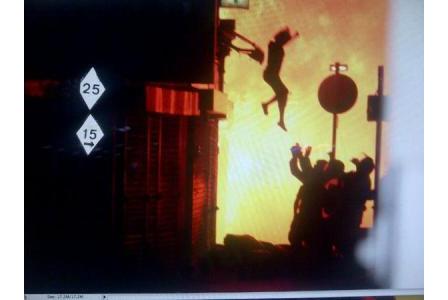
POLICE AND businesses in London prepared for a fourth night of unrest last night as widespread violence spread from north, to east, west and south.

Ger Donaghy, originally from Antrim, watched from his home above retail outlets on Ealing High Street in west London, as at least 200 youths, some as young as 16, ransacked businesses and attacked police.

He said rioters smashed and looted properties along the high street and set fire to a local convenience shop under a row of second-storey residential flats.

Mr Donaghy said he saw about five cars ablaze during the two-hour attack on Monday night, and witnessed the looting of two children’s clothes shops, an Oxfam charity shop and numerous cafes and restaurants.

“The rioters were kicking in windows of all the shops along the street and coming out of restaurants with chairs, bottles and whatever they could get their hands on to use as weapons to throw at the police.”

The crowd dispersed to other areas of Ealing at about midnight, and when local residents ventured out to assess the damage they found “children’s clothes littered all along the street” and “glass everywhere”. In Lewisham, a multi-ethnic area in southeast London, youths set fire to cars and bins and had running clashes with police outside a shopping centre, with unrest reported on Monday afternoon.

Looters broke into a jewellery shop and the windows of a local McDonald’s were smashed. The local bar had all its windows broken and was looted.

Rioters smashed their way into the Dirty South bar at about 7pm on Monday evening, tearing out fruit machines and fridges while also grabbing cash and alcohol. Bar manager Laura Warby said she was not on the premises when the looting took place and asked why the police were powerless to prevent the incident from happening.

“I am so shocked. I really have no idea why they would attack our place and why we weren’t protected by the police. This is going to cost thousands of pounds to repair,” she said.

There was a large police presence in Lewisham and in the neighbouring area of Catford yesterday evening, which also experienced some small pockets of copycat violence on Monday.

Further southeast in Bromley, the city’s biggest borough, police cordoned off the high street and train station yesterday afternoon, following sporadic flashes of violence in the area on Monday night.

Tensions were high in the area yesterday with many shops closing and some retailers boarding up amid fears of looting.

Sid Bussey, a local business owner in the nearby area of Downham, said shops were advised by police to close early with rumours that surrounding areas would be targeted by rioters.

“I’m refusing to close up early. Why should I?” he asked. “It’s the job of the police to protect us and our livelihood, and if they can’t protect us then we’ll have to protect ourselves.

“I’ve been here in this shop for the last 42 years and I’ll fight to the death before I let some kid loot it. This is nothing but kids with nothing better to do other than to cause trouble,” he said.


MOB violence' rocks Manchester

Police say they've been faced with extraordinary levels of violence on the streets of Manchester from hundreds of criminals hell-bent on causing destruction.

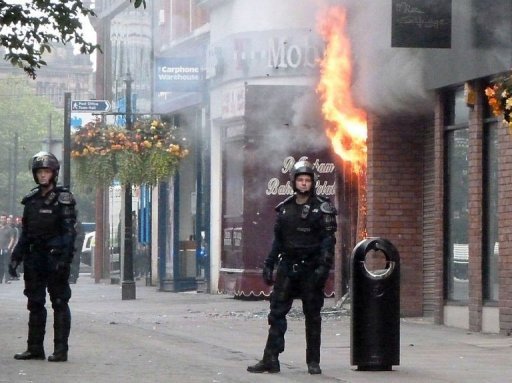
Fire bombs were thrown at shops and windows were smashed as looters made off with designer clothes, expensive electrical items, jewellery, mobile phones and alcohol as the violence gripping many English communities spread to the northwest city.

Youths - many wearing masks and hooded tops - plundered Manchester city centre and nearby Salford shopping precinct from about 5pm local time on Tuesday (0200 AEST Wednesday).

Some of those running wild looked to be as young as nine or 10.

The chaos ensued for hours and calm was not largely restored in both locations until about 1am as a total of 47 arrests were made with officers from Northumbria, Staffordshire and North Wales assisting Greater Manchester Police (GMP).

Sporadic looting broke out across the city centre with gangs playing cat and mouse with riot police, who took control street by street in a bid to flush out the offenders.

Former Oasis frontman Liam Gallagher's recently-opened fashion boutique - Pretty Green - fell victim to the looters, while a women's clothing store was set alight.

At Salford Shopping City, glass from shop windows and bus shelters littered the streets along with house bricks and rubble used to pelt riot police.

Two cars, one believed to be a BBC radio car, lay overturned and burnt out.

Firefighters came under attack from missile-throwing yobs as they attended incidents.

GMP Assistant Chief Constable Garry Shewan said: 'Criminals have brought shame in particular on the streets of Salford and Manchester.

'We want to make it absolutely clear - they have nothing to protest against. There is nothing in a sense of injustice and there has been no spark that has led to this. This has been senseless violence and senseless criminality of a scale I have never experienced in my career before.

'Over the past few hours, GMP has been faced with extraordinary levels of violence from groups of criminals intent on committing widespread disorder.

'This is nothing more than senseless violence with absolutely no regard for people, their property or livelihoods. These criminals have also attacked some of my officers and other emergency services who are simply trying to do their job to keep the public safe and restore order.'

He said that offenders had been caught on CCTV and his message for them was 'we will be coming for you'


Some armed with swords, some carrying hockey sticks, defiant Sikhs stood guard outside their temples last night.

Some armed with swords, some carrying hockey sticks, defiant Sikhs stood guard outside their temples last night.

More then 700 men, some in their 80s, took to the streets to protect the homes, businesses and places of worship in Southall, West London.

The locals rallied to keep the rioters at bay following reports of a planned attack on the area. It is just a few miles from Ealing, which was targeted on Monday night.

Each of the Sikh temples was guarded by around 200 men.

Resistance: Dozens of Sikhs stage a display of defiance against the rioters outside London's largest temple in Southall yesterday

Resistance: Dozens of Sikhs stage a display of defiance against the rioters outside London's largest temple in Southall yesterday

Amarjit Singh Klair from nearby Hounslow, who helped rally the men, said: ‘We are working along side the police, they’re doing what they can but they are stretched. 

‘Why shouldn’t we defend our homes, businesses and places of worship? This is our area. There’s lots of talk about it kicking off here. But we’re ready for them.’

Hooded youths could be seen scouting the area but appear to be have frightened off. Only a handful of police could be seen patrolling the area.


Monday, 1 August 2011

Police operation against triad and street gangs activities

Police yesterday (July 27) arrested 53 males and eleven women in an operation codenamed "Deepocean", which aimed at combating triad activities involving teenagers as well as street gangs activities.

Crime Unit of Kowloon East Region initiated the intelligence-led operation since January this year. An undercover police officer was deployed to gather crime information on several active triad societies in Kowloon East, involving cases in which teenagers were asked to take part in illegal activities.

The operation turned overt yesterday evening after in-depth investigation. Police raided various locations such as restaurants, cyber cafes and residences, resulting in the smashing of two gambling establishments and the seizure of small quantities of suspected cocaine and ketamine as well as some offensive weapons including beef knives, water pipes and extended batons.

In the operation, eleven women aged between 29 and 65 were arrested for illegal gambling related offences.

The remaining male arrestees, aged between 13 and 44 and including suspected core members of triad societies, were arrested for various offences including managing a triad society, claiming to be a member of a triad society, acting as a member of a triad society, robbery, wounding, criminal damage, trafficking in dangerous drugs and illegal gambling.

The operation is still under way. It is believed that the operation succeeded in combating triad and street gangs activities in the region. Police will continue to take enforcement action and step up patrols at venues frequented by teenagers, particularly during the summer vacation.


One of Israel's top organized crime figures has been gunned down in a drive-by shooting.


Police say two men on a motorcycle opened fire on Francois Abutbul early Sunday as he stopped to fill up at a gas station north of the coastal city of Netanya.

Police say the Abutbuls are one of the most powerful families in Israeli organized crime. Abutbul ran the family business along with his brother Assi, who serving jail time for extortion, arson and unlawful imprisonment.

The family patriarch, Felix, was assassinated in 2002 at a Prague casino.

Gang violence has been rising in recent years, with incidents of rocket attacks, bombings and shootings in public places.

Police say one of Abutbul's bodyguards was lightly wounded in the shooting. No suspects have been arrested.

Drug gang leader says he ordered 1,500 killings

suspected leader of the Juarez drug cartel told authorities he had ordered the deaths of about 1,500 people, a Mexican federal police official said Sunday.
Federal police detailed accusations against Jose Antonio Acosta Hernandez, known as "El Diego," a day after authorities announced his capture. He was one of the country's most wanted criminals, with officials offering a reward of 15 million pesos ($1.3 million) for his arrest.
Collaboration with the U.S. Drug Enforcement Administration led to Acosta's detention, said Eduardo Pequeno, head of the Mexican federal police anti-drug unit.
Acosta is accused of being a leader of the drug gang known as La Linea, the enforcement arm of the Juarez cartel, Mexican authorities have said.
Pequeno told reporters that Acosta "said he ordered the killings of about 1,500 people, mostly in Ciudad Juarez and Chihuahua's capital."
An investigation points to Acosta as the mastermind behind the March 2010 killing of three people connected with the U.S. Consulate in Juarez, Pequeno said.
More recently, Acosta ordered operatives to hang banners with threatening messages directed at the DEA and other U.S. authorities, Pequeno said.
Juarez, Mexico's most violent city, shares a border with El Paso, Texas.
Pequeno also accused Acosta of having connections with some of the border city's most notorious violence over the past two years, including the 2010 killing of a state prosecutor, a car bombing outside a police station and a massacre at a house party that killed 15 people -- most of them students with no ties to organized crime.
Acosta told authorities the targets of his criminal organization included police, government officials, rival drug gangs and civilians, Pequeno told reporters.
Earlier this month, the U.S. consulate in Juarez issued a statement warning "American citizens to remain vigilant" based on information it had received that cartels may target the consulate or entry points on the U.S.-Mexico border.
The northwestern Mexican state of Chihuahua, which contains the namesake capital city as well as Juarez, has been a hotbed for drug-related violence.
The federal government has been targeting cartels' operations, and especially its leaders, in an ongoing battle.
Mexican authorities have arrested several others they accuse of being connected to the slayings of three people connected with the consulate last year.
The shootings occurred March 13, 2010, when consulate employee Lesley Enriquez and her husband, Arthur Redelfs, were gunned down as they left a birthday party in their white SUV.
Jorge Alberto Salcido Ceniceros, the husband of another consulate employee, was killed in a separate vehicle.


Monday, 11 July 2011

There was a time when everything and anything was done in pursuit of the perfect crime news story.

The News of the World is closing amid a major scandal over phone hacking and alleged payments to police officers, but once upon a time journalists went even further to get the ultimate story, 
There was a time when everything and anything was done in pursuit of the perfect crime news story.

The allegations being made about dubious journalistic practices at the News of the World are shocking and immoral if proven to be true.

But the current row takes us back to the 1940s and 1950s when hacks on that very same tabloid and other papers were just as clandestine in their methods, and with even fewer legal restrictions.

In the years after World War II, the print media's response to the horrific crimes of three of the most infamous killers in the annals of British crime whipped up an almost identical furore.

Continue reading the main story
Postwar murderers

John Christie: Landlord who gassed eight people and sexually interfered with their corpses. Hanged in 1949
John Haigh: Claimed to have drunk the blood of the six victims he disposed of in vats of acid. Although he tried to plead insanity, Haigh was convicted and hanged in 1949
Neville Heath: Brutally murdered two women in London. He was executed in 1946
The three serial killers Neville Heath, a "charmer" who murdered two or possibly three women; John George Haigh, who murdered at least six people and disposed of their bodies in acid; and John Christie, the monster of Rillington Place who killed seven or eight people and watched Timothy Evans hang for one of those murders.

These dangerous men were made into macabre pin-ups by the popular press of the time, the immediately post-war world where London and other cities were cratered and scarred by Hitler's bombs.

The practices of two legendary Fleet Street crime reporters - Norman "Jock" Rae of the News of the World and Harry Procter of the Mail and later the Sunday Pictorial - stand out from the rest of their peers.

With the chequebooks of their editors in hand, these hardened and tenacious hacks chased down the stories of these murderers, and tried to get them at any cost.

These were the days when the News of the World sold more than 8 million copies every Sunday, and every effort was made to get a crime scoop, the more grisly the better.

Rae and Procter were highly regarded by their editors, as their crime stories produced great spikes in circulation. When a rival paper bought a helicopter to get to stories faster in the late 1940s, Procter's editor said: "They may have a helicopter, but we've got a Harry Procter."


Public appetite for stories about killers like Haigh was intense
Fleet Street's crime reporters were star journalists then, and became known as the Murder Gang, with incredible contacts amongst the police, judiciary and legal system.

Payments were made without a second thought, and papers such as the News of the World and the Sunday Pictorial got the best inside morsels of information, as the Sunday papers paid more than the dailies.

Incredibly, these hacks got the full inside stories on Heath, Haigh and Christie, and in return paid their legal defence costs - in two cases, they made substantial payments to the families of two of the killers after they were executed.

Sunday's crime confession scoops were always tomorrow's fish and chip paper, but copies were sold on the day, and that was all that was important. Today laws and media regulations prevent criminals profiting from their crimes, but in 1946-53, there were no such restrictions (although one rival editor did go to prison for contempt of court).

Continue reading the main story
George Orwell on murder coverage

"The wife is already asleep in the armchair, and the children have been sent out for a nice long walk," wrote George Orwell. "You put your feet up on the sofa, settle your spectacles on your nose, and open the News of the World."

And what will you read? "Naturally, about a murder."

Orwell described Sunday afternoons spent devouring reports of heinous slayings as "blissful". But in his 1946 essay Decline of the English Murder, he feared that lurid crime reporting had passed its peak.

He lamented the demise of the "perfect" murder, which had been so common in the pre-war days. This would involve a "little man of the professional class" who risks losing his social standing by "cherishing a guilty passion for his secretary or the wife of a rival professional man".

Such crimes - Dr Crippen's is held up as a prime example - "excite pity for both victim and murderer".

But Orwell complained that wartime and postwar murders were tawdry by comparison, reflecting an age of "dance-halls, movie-palaces, cheap perfume, false names and stolen cars".

Procter met Neville Heath on at least two occasions before Heath committed his first murder, and had face-to-face interviews with John George Haigh and John Christie before either was arrested or charged.

Even murkier was the fact that Rae arranged to secretly meet with Christie to get his inside story for the News of the World while the serial killer was on the run - a time when every police force in Britain was on the lookout for him.

This was an era when the disarray on the city streets, heavy rationing and the heavy hangover of the war was matched by the immoral practices of tabloid hacks driven to get results for their newspaper, and to do so at any cost.

The current allegations surrounding the News of the World of phone-hacking and reporters' investigations into the families of murder and terrorism victims and slain soldiers can be seen in the light of the actions of hacks from 60 years ago.

The world of dark celebrity, which Rae and the rest of the Murder Gang helped build, truly was the seed of the tabloid crime coverage we see around us today.

The immense pressure on tabloid journalists to "push the envelope" and use every method necessary to get their scoop has not changed, as the current scandal shows.

From the time that Rae and Procter were operating, and most probably long before, tabloid hacks have had to be flexible to the point of immorality to get the type of stories that made their paper fly off the stands.


Reporters like Rae and Procter were the superstars of Fleet Street
But the News of the World has not been the only culprit, and these are practices which have undoubtedly been systemic in the British tabloid world generally for decades.

The drug bust in 1967 involving the Rolling Stones had tabloid media on the scene as fast as the police, prompting later suggestions of collusion.

William Rees-Mogg wrote in his Times leader of the Rolling Stones drug bust: "Why break a butterfly on a wheel?"

The situation now at the News of the World seems to be the straw that finally broke the tabloid camel's back.


The Las Vegas Mob Experience is located at the Tropicana Hotel, 3801 Las Vegas Blvd. S

You've always come here for experiences: at the gaming tables and buffet tables, in the lounges and showrooms, or just gawking at surreal replicas of world landmarks in the middle of the desert.

Now, when you come here, you can also get rubbed out by Soprano-style bad guys with thick necks, Brooklyn accents and automatic weapons — virtually, of course.

IF YOU GO

The Las Vegas Mob Experience is located at the Tropicana Hotel, 3801 Las Vegas Blvd. S, on the Strip. General admission is $39.95.
Information: www.lvme.com, 702-739-2662.
The Museum of Organized Crime and Law Enforcement is located at 300 Stewart Ave. downtown and will open next February.
Information: www.themobmuseum.org, 702-229-6581.
The Tropicana Hotel launched the Las Vegas Mob Experience this spring: part museum, part theme park, with nifty interactive special effects designed by Disney "imagineers."

The visitor becomes a character in the story, and has choices to make. The wrong one could get you whacked. The right one — per the underworld code of morality — you get "made."

There's a T-shirt for either outcome in the gift shop.

The Tropicana "experience" is the first of two installations charting the rise and fall of Mafia involvement in Las Vegas.

Miami Beach mob boss Meyer Lansky and his top lieutenant, Hollywood's Vincent "Jimmy Blue Eyes" Alo were in on it from the start as associates of Lucky Luciano and Benjamin "Bugsy" Siegel in turning the Flamingo Hotel into first casino resort in 1946.

Not yet up and running: the city's official "mob museum" — formally the Museum of Organized Crime and Law Enforcement. The $42 million project, housed in a 1933 downtown post office/federal courthouse, is set to open on Feb. 14, 2012. The date is deliberate, since one of its marquee attractions will be a section of the Chicago garage wall in front of which seven Prohibition-era hoods met their demise on Feb. 14, 1929, in the notoriously bloody St. Valentine's Day Massacre. Look for the original machine gun-slug pock marks.

The facility also snagged the barber chair in which New York crime boss Albert Anastasia died amid a hail of bullets, and an audiotape from an actual "made man" induction.

The Tropicana's Mob Experience is part of an overall, $200 million hotel renovation by the South Florida-based Nikki Beach Club entertainment group.

What you get for $39.95 and about an hour at the Mob Experience is a chance to role-play actual wiseguys, also Mafia-flick actors like James Caan and Mickey Rourke as holographic narrators, and an impressive collection of memorabilia, in a 26,000-square-foot display.

The flashiest find: Bugsy's 1933 Packard limo, impeccably restored. But some might be more entranced by Lansky's handwritten diaries, in which he muses about his destiny. Visitors can turn the pages electronically, and read a transcript.

"My role wasn't assigned to me," Lansky wrote. "I chose my role the same way as any businessman chose his role. I listened, and read a lot about men in all kinds of endeavors. The men who mostly went to the top were men with integrity. Whatever business I decided to be in would never change my principles."

Jay Bloom, managing partner of the Mob Experience, calls the diaries — acquired from Lansky's granddaughter, Cynthia Duncan of Miami — one of the attraction's "Holy Grails."

He said he cold-called Duncan, who ultimately offered a trove of photos and artifacts and consulted on the project.


The Alo artifacts came from his niece, Carole Russo, also of Miami.

All the major Vegas-related characters are represented, including Luciano, enforcer Tony "The Ant" Spilotro, Hank Greenspun (the Flamingo publicist who later ran the Las Vegas Sun newspaper), Frank "Lefty" Rosenthal, Frank Costello, Sam Giancana, casino owner Allan Sachs, tycoon Howard Hughes, and entertainers Frank Sinatra and Eddie Fisher.

Some artifacts Bloom said he politely declined, including Louisiana crime boss Carlo Marcello's teeth.

Some vocal critics, including academics, have panned the project for romanticizing organized crime and glossing over the violence and corruption which, as much as the block and plaster, built Sin City. But Bloom defends the premise.

"The families did not see these men as psychotic killers," Bloom said during a walkthrough days before the March 29 grand opening. "Yes, they killed, but they were also religious. They stole, but they were generous, and they tried to shield their families from their business.

"The families were discouraged with the way Hollywood portrayed them."

So, because every gangster needs a moniker, that's what you get first thing in the door, along with a bar-coded badge that will trigger various activities in your native language as you proceed through the exhibits.

If a guide gets you to give up your cellphone number, you'll get an extra dimension of interaction when you least expect it: a phone call from an actual "made man." And he'll know your name.

I become Peanuts, an amusing coincidence for one who is vertically challenged.

The exhibit begins with the Italian immigrants who came through Ellis Island and planted the seeds of La Cosa Nostra on New York's Lower East Side that ultimately sprouted in the Midwest, New England, California and, by the 1940s, Nevada.

One of the holographic narrators — Caan, who played Sonny Corleone in the "Godfather" films — in a sharksin suit and silver tie, explains the mob's involvement in bootlegging. Then he tells you to go down the alley and knock on the last door on the left.

A slot opens. A guy in a loose tie with a cigar hands you an envelope. You are now a "bag man."

"Give it to Big Leo," he says. "And watch your back."

A pair of guidos lead us to a guy draped in gold jewelry, including the requisite giant pinkie ring, relaxing with a bottle of red wine at a cafe table.


"Treat Big Leo wit' due respect," one of them warns. "If da cops pick you up, I'll help you in da jail."

"We're very big in Miami," Big Leo says, having been cued by my badge.

The room devoted to Lansky and Alo all but brings them to life through talking holograms, home movies, audiotape, family snapshots and personal effects: Meyer's iconic white shoes, hat and light-blue sportcoat in a glass case. His bow tie collection and leatherbound library. His Social Security card, silver cigarette case, his glasses and their case from Sutton Optical, 1660 Meridian Ave., Miami Beach.

His Dade County "declaration of domicile:" 5255 Collins Ave., apartment 2-A; his love letters to his wife, Teddy — "keep your legs crossed and go to sleep" — and his written pleas to the president of Israel seeking asylum, as the federal government pursued him near the end of his life.

A front page of the old Miami News on Jan. 15, 1983, announces his death at age 80.

There's nearly as much on Alo, Lansky's tight-lipped advisor, who helped run mob operations in Vegas, Florida and Cuba.

An avid golfer, he's pictured on a golf course mid-swing, riding a burro in Cuba, and outside his house in Hollywood, Fla., with his wife, Florence.

He died of natural causes in 2001, a widower just shy of his 97th birthday.

"Alo took on near-mythical status in the world of organized crime," a plaque reads. "To the average foot soldier in the mob, it was unfathomable that Lansky (who was Jewish), could be one of the biggest bosses in the world of organized crime and have an Italian (Alo) as his right-hand man. Surely, they thought, Lansky had to be working for Alo, not the other way around."

While the Mob Experience is long on flash, the Museum of Organized Crime and Law Enforcement promises a more sober look at the same era, roughly the post-war 1940s to the mid-1980s, when the casinos went legit, with greater emphasis on the crime fighters who drove the mob out than on the gangsters themselves. In fact, Sen. Estes Kefauver's Special Committee to Investigate Crime in Interstate Commerce held hearings in the building's main courtroom in 1950 and '51.

His aim was to shut the casinos down. Precisely the opposite happened, making Las Vegas the center of the gambling universe.

The museum is the brainchild of Oscar Goodman, Las Vegas mayor from 1999 until his wife replaced him in June. The former mob lawyer doesn't see the Tropicana project as competition, and can barely tolerate the mention of its name.

He had a sentimental feeling about the building that will house the city's museum, because it's where he tried his first federal case. The city bought it from the feds for $1, with the proviso that any renovation had to meet national landmark guidelines.

"We will have a museum second to none!" Goodman declared.

He explained that in the end, the racketeers ran themselves out of business because "they got greedy and sloppy, and didn't realize about the government wiretaps."


He said the museum would be "an educational experience. This is really America's story."

The 43,000-square-foot space spans three floors and a basement, and will retain original windows, oak flooring, hardware, marble, brass post-office boxes, heavy safe doors and other architectural features.

Working off original blueprints, designers were able to recreate just about everything they couldn't find or salvage, from chandeliers to leatherette doors.

Kathy and Dennis Barrie, who created the International Spy Museum in Washington, D.C., were hired to do the same in the old Vegas post office. With most of the construction work finished, they began installing exhibits in mid-June.

"We collected from a number of people in the FBI or their children," Dennis Barrie said. "We also are working with a couple of major collectors of organized crime material."

There will be a car from "a recently deceased mobster," 3-D projections in the courtroom, federal-agent weapons training and wiretapping exhibits, and a feature that "lets you trace mob activity in your own community," Barrie said.

There's material from South Florida and from Tampa, which had an active underworld.

"We'll have a lot of interactivity, but no live actors," he said. "That's pretty hokey."

They do, however, have audio and video of John Gotti, some of the Dapper Don's clothing, and "a whole exhibit on mob hits."

"We want to show the interconnectivity of the mob, politicians, judges, labor leaders and famous celebrities," Barrie said. "These people are not cartoons, and you can't exclude talking about the really bad things these guys did."

Monday, 13 June 2011

Two more men arrested in Oceanside murders, 3 suspects total

Two more men have been arrested in the murders of two Oceanside teenagers bringing the total number of suspects to three.

One of the suspects is 19-year old "Al'c Bejaran". The other two suspects have not been identified.

Bejaran is accused of gunning down 16-year-old Fernando Solano and 14-year-old Sandra Salgado at Libby Lake Park in Oceanside May 3rd.

Court records show Bejaran is a member of the Crips street gang and just last year pleaded guilty to attempted grand theft.

Bejaran violated his probation, received an 8 month prison sentence and then violated his parole.

He is set to be arraigned Monday on two counts of murder.


Hells murder trials begin

Two trials involving 51 men alleged to be members of the Hells Angels, or associates of the biker gang, saw their trials on multiple murder charges officially begin Friday.

The words "not guilty" were repeated often at the Gouin courthouse as 50 of the accused entered their pleas to many charges including one count of conspiracy to commit murder as well as 22 first-degree murder charges. One of the accused could not attend the hearing because he is currently being treated for stomach cancer.

Not all of the accused are charged with the murders, which occurred within the context of a conflict over drug trafficking turf between the Hells Angels and other organized crime groups. The prosecution's theory is the gang voted in favour of the war and contributed to it being carried out, roughly between 1994 and 2002. The 51 accused are expected to be tried in two separate trials and are split based on which chapters - Sherbrooke and Quebec City - they are allegedly affiliated with.

Superior Court Justice James Brunton presided over one hearing, involving 29 men alleged to be part of the Sherbrooke chapter while Justice Martin Vauclair handled a case involving 22 accused in another room at the courthouse which was specially built for such large trials.

The hearing was the first related to Operation SharQc since Brunton's bombshell decision on May 31 to place a stay of proceedings on the cases of 31 people who were only charged with drug trafficking in a major police investigation that produced indictments against 156 people in all. One has since died and 19 are still being sought by police.

In the same decision, Brunton set the timetable, which officially began Friday. Under that plan, five separate murder trials will be held. People alleged to be members or associates of the South and Trois Rivières chapters will be tried in 2013 and the Montreal chapter in 2015.

However, Brunton made it clear Friday that things could change before a jury or a judge begins hearing evidence. Lawyers will return to the courthouse in September for a two-week hearing to analyze the Crown's evidence. Following that, Brunton said, some of the accused might request a trial before a judge alone while another group might prefer a trial before a jury. Brunton said if that happens there should be no problem with transferring an accused from one case to the other.

"Your work starts now," Brunton told the many lawyers gathered in his courtroom Friday morning. He also noted many of the accused in the Sherbrooke chapter case have yet to hire lawyers. He urged the men to hire an attorney soon and advised them having an attorney will become crucial in the coming months.


Russian Mafia to Flood Stratford with Drugs and Prostitutes

The new Westfield Stratford City shopping centre and the new transport links to and from Stratford are certainly improving East London and Stratford. However, the latest news will certainly not improve the reputation of East London and not make people want to move to the area.

It has been reported that ruthless gangsters from the Russian Mafia are setting up businesses around the Olympic site in Stratford hoping to cash in on the London 2012 Olympics. Olympics organisers and Scotland Yard are facing a tough battle to keep the area safe to the general public as mafia groups start to invade the capital.

With hundreds of thousands of tourist expected in the capital next summer, mafia groups are organising network to provide prostitutes, cocaine and to racket small businesses. Despite the plans to set up a brand new casino within Stratford City, gamblers could also be targeted in illegal betting rings.

Sources at Scotland Yard’s organised crime unit say that Russian families have already set up businesses near the Olympic site and are suspected of laundering millions in illegal cash. Network of escort girls and drug trafficking are believed to be already in place in and around Stratford.


Latino gang member gets life in prison for his part in the 2008 killing of a black man outside a bowling alley

25-year-old Latino gang member convicted in the racially motivated gang murder of a black Canoga Park bowl­ing alley employee has been sen­tenced to life in pri­son with­out pa­role.

Mar­tin Sotelo, a member of the Canoga Park Al­abama gang, was sen­tenced Thursday for the fa­tal drive-by shooting of James Shamp. Van Nuys Supe­rior Court Judge Mar­tin Herscovitz also or­dered Sotelo to pay $15,916 in restitution for the burial of his victim and mental health costs of the victim's fam­ily.

A ju­ry in April found Sotelo guilty of first-degree murder with two special circum­stance al­legations, murder because of the victim's race and murder in a drive-by shooting. He was the last of four defen­dants to face charges in the case.

He was also found guilty on oth­er al­legations, including evading offi­cers af­ter the shooting and sec­ond-degree rob­bery related to a sep­a­rate in­cident. The additional charges resulted in a sen­tence of 40 years to life.

Sotelo's lawyers maintained that their client har­bored no prej­u­dice against blacks and had no in­tention of committing a hate killing on Dec. 22, 2008, the night of the shooting. But pros­ecutors said Sotelo was seeking bragging rights and trying to live up to his gang moniker, "Out­law," when he willfully partic­ipated in the murder.

Shamp, 48, a married fa­ther of two, was taking out the trash at the Canoga Bowl when Latino gang members pulled up in a car and fired the shots, pros­ecutors said. Sotelo was behind the wheel.

Deputy Dist. Atty. Daniel Akemon of the Hardcore Gang Divi­sion said Sotelo helped fel­low gang member Richard Bor­de­lon gun down Shamp "in cold blood because of the col­or of his skin,        in a display of sense­less vio­lence and a complete disregard for human life."

Akemon argued that Sotelo had stopped the vehicle so Bor­de­lon could take aim like a sniper. Bor­de­lon's bul­let struck Shamp "right through the heart," Akemon said.

In March 2010, Herscovitz sen­tenced Bor­de­lon to life in pri­son with­out the pos­sibility of pa­role, plus 47 years to life, af­ter he admitted be­ing the gunman. Bor­de­lon was also or­dered to pay $14,386 in restitution. A juve­nile defen­dant, 15 at the time, also reached a deal with pros­ecutors and was sen­tenced on a juve­nile con­spir­acy charge.

A third defen­dant, Or­lando Perez, a 25-year-old Latino, pleaded no con­test to a charge of accessory af­ter the fact to murder and was sen­tenced to three years and four months in state pri­son.

Akemon told ju­rors in clos­ing argu­ments earli­er this week that Sotelo and Bor­de­lon were out that December evening looking to earn their respective nicknames of "Out­law" and "Psycho."


Related Posts Plugin for WordPress, Blogger...

 
Design by Free WordPress Themes | Bloggerized by Lasantha - Premium Blogger Themes | Blogger Templates